




Game info
Territory capture, Arcade strategy
Learn original Paper.io gameplay, swipe controls, safe loops, trail protection, territory shapes and cutoff tactics, with official Voodoo resources.
About Paper.io
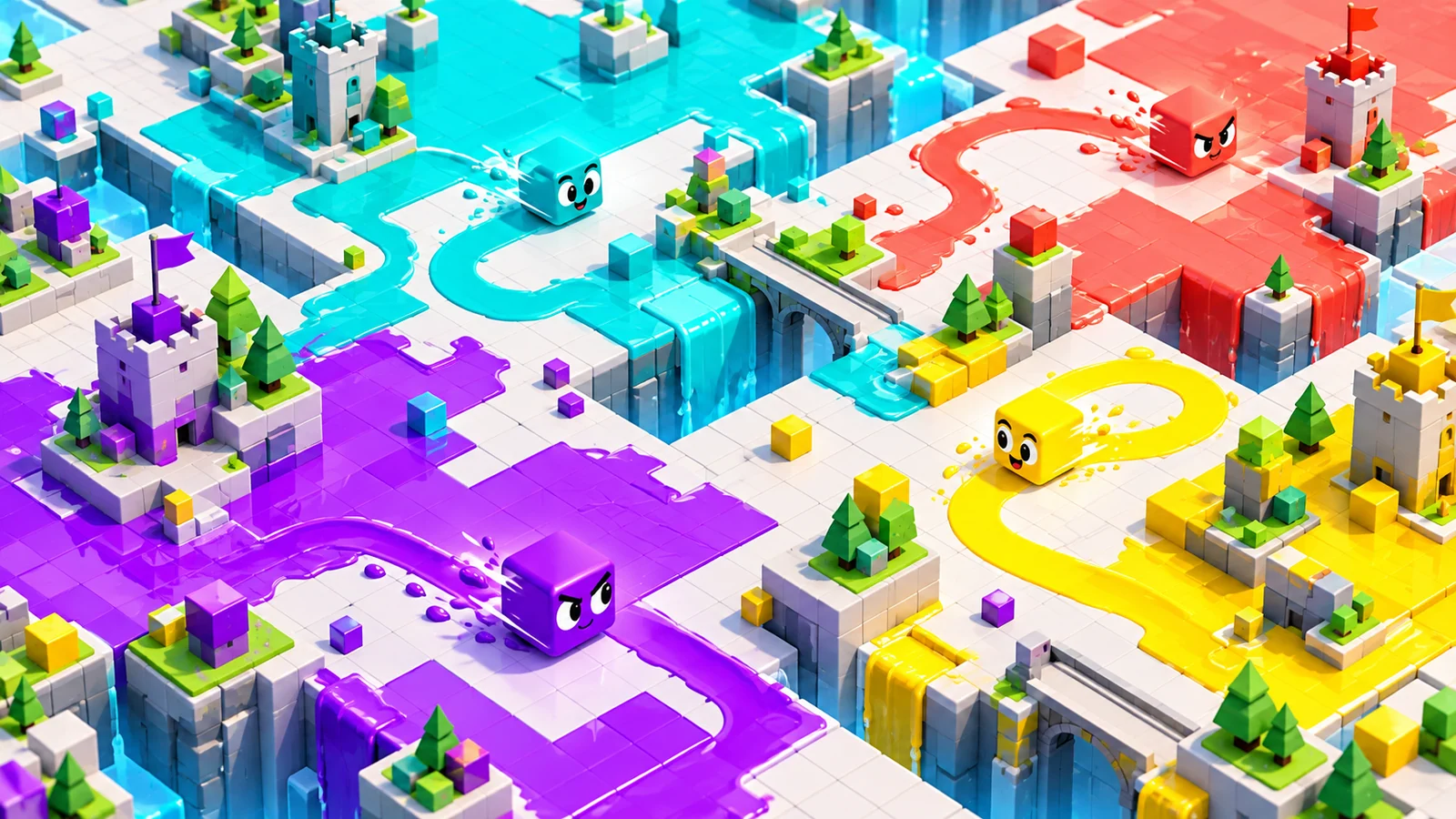
Paper.io is Voodoo’s territory-capture game about drawing a line you can safely close. Leave your coloured area, travel around an unclaimed patch and reconnect with your territory to add the enclosed space. While you are outside, your trail is vulnerable. The challenge is choosing an expansion worth the time spent exposed.
Voodoo’s official Paper.io page describes the original game’s objective: conquer more space while preventing an opponent from touching your tail. A strong opening is usually a modest capture with a clear return, not the longest possible trip across the board. The sections below explain original Paper.io movement, territory shape, trail protection and attacking decisions. Learn how each successful loop changes the next position before turning a safe opening into a larger expansion.
Gameplay Overview: The Original Territory-Capture Idea
The core idea is easy to demonstrate with a small loop. Move out from a safe boundary, turn around a modest patch of blank space and return to your colour. The return completes the capture. A longer loop can add more territory, but it also leaves a longer trail available for an opponent to cut.

This makes Paper.io different from simply colouring a board. You must consider the route’s length, the shape of the area gained and the position of nearby rivals. A wide empty region is not automatically a good first target if an opponent is already moving toward your exposed line. Begin with a capture that returns close to where you left, then use its new boundary to plan the following expansion.
Gameplay Overview: How to Play
Start a round and identify your colour before moving away from it. Make the first capture small enough that you can watch the whole exposed trail. Reconnect, check which area changed colour and notice where the next safe departure point now lies. That sequence explains the goal more clearly than beginning with a sweeping trip across the map.
For a first practical route, leave one side of your territory, travel a short distance, turn across and reconnect on a nearby edge. After that capture, expand from the side with the clearest space. If a rival approaches while you are drawing, shorten the loop and return sooner. The area you hoped to claim is not more important than closing the line that keeps the current run alive.
Gameplay Overview: Controls
Use directional swipes to steer Paper.io’s moving piece around the board. Start with a small change of direction near your coloured area and notice where the turn occurs. A clean loop depends on making the next turn before the piece travels farther outside than you intended.
Keep the gestures deliberate enough to create the shape you planned. Several hurried corrections can lengthen the trail or carry the piece beyond the intended return edge. Leave the screen visible around your finger so that you can still see the next turn and a nearby opponent. The official Paper.io Android listing identifies Voodoo’s native release and its app information. For practical play, practise steering a small loop until the return feels repeatable, then increase the outward distance gradually.
Gameplay Overview: Pro Tips
Make the first expansion a clean return, not a dramatic percentage gain. An early territory lead can disappear if the next loop runs across a rival’s path. Look at the direction nearby opponents are travelling and choose a departure point that gives you time to complete the capture.
Useful Paper.io tips include:
- Expand from an edge that leads toward open space.
- Choose your return point before leaving your colour.
- Shorten a loop when an opponent approaches its exposed side.
- Avoid adding a narrow extension that creates more boundary than useful space.
- Recheck the new territory after every capture instead of repeating the previous turn automatically.
The best route is not always the largest shape. It is a shape you can complete and use as a safe starting point for another controlled expansion.
Key Features of Territory Play
Territory play combines movement, geometry and attention. Movement determines whether you can draw the route cleanly. Geometry determines how much useful space the loop encloses. Attention determines whether you notice a rival before the exposed trail becomes an easy target. A good round needs all three, even though the controls themselves may be simple.
Paper.io also makes the board change after every successful move. A return edge that was safe earlier may become crowded, while a small new capture may open a much better approach to an empty region. Treat each completed loop as a new position. The coloured area is not just a score display: it changes which routes are short, where you can retreat and how quickly an opponent can reach your next exposed line.
Advanced Tips: Measure Risk by Exposure
Compare captures by time outside, not area alone. Suppose one route surrounds a large region but spends a long stretch far from your colour. Another adds a smaller block and reconnects almost immediately. If a rival is approaching, the shorter route may give you a useful gain while leaving far less opportunity for a cut.
A practical way to judge a loop is to trace its return before starting. Notice the longest exposed side and ask which opponent could reach it first. If that side runs beside a busy route, reduce the outward distance or choose a different edge. You do not need a numerical risk formula. Simply recognising that a long return path stays vulnerable after the first few turns can prevent an overambitious capture.
Build a Territory You Can Defend
A compact territory gives you several nearby places to reconnect. A thin arm extending across the map can look impressive while offering fewer safe choices along its sides. When growing, ask whether the new shape improves your next position or merely makes the colour cover more ground.
Try filling shallow gaps and smoothing an awkward boundary before creating another long extension. This can make your next departure shorter and leave a clearer view of the exposed line. If a rival keeps approaching one edge, expanding elsewhere may be more effective than repeatedly contesting that same narrow strip. Defence in Paper.io begins with the territory shape you choose to create, because that shape decides how much time your future routes spend away from safety.
Your Territory Is the Main Playing Piece
Think of your territory as a network of return points. A broad, readable area gives you options for closing a loop early if the situation changes. A ragged area with several narrow necks can make the intended return less obvious while your attention is on an opponent.
After a capture, pause your ambition long enough to inspect the edges you can use next. Which one is closest to unclaimed space? Which one has a rival moving toward it? Which return can you reach without passing through the busiest part of the arena? These questions turn the growing patch of colour into a practical tool. You are not simply defending a percentage; you are arranging the board so that the next exposed movement can be shorter and easier to read.
Attacking an Exposed Trail
An exposed enemy trail is a possible target, but chasing it creates your own exposure if you leave safety. Compare the two routes before attacking. If the rival can reconnect before you reach the line, continuing the chase may leave your trail vulnerable without producing a useful result.
The cleanest opportunity is often a nearby exposed segment that crosses a route you can complete quickly. Cut across only when you can see how to return afterward. Avoid following a distant enemy head around the map merely because its trail was briefly reachable. Once that opportunity closes, switch back to protecting your own route. A sensible attack improves your position; a frustrated chase can turn a safe territory into the starting point of an unnecessarily long, fragile line.
Opponents and the Original Paper.io Objective
The original Paper.io objective is to take territory while protecting an exposed trail. Treat each opponent as a moving threat to that line. Its current direction and distance determine whether you can finish a capture before it reaches the vulnerable side. A small change in an opponent’s route can turn an easy-looking expansion into a poor risk.
The original Paper.io App Store listing describes play without an internet connection. That means the central challenge does not require a live match against human opponents. Offline play still demands attention to the movement on the board: computer-controlled rivals can interrupt an exposed route just as the game’s rules allow. Judge the next capture by the space and threats you can see, not by assumptions about who is controlling the nearest piece.
Advanced Tips: Compare Two Small Routes
Take one departure edge and imagine two expansions. The first travels far outward before turning back. The second captures a shallower patch and returns nearby. Compare the longest exposed side of each route, the closest rival and the quality of the territory shape after returning.
Now test the shorter route several times before enlarging it. You may find that two small captures create nearly the same useful area as one risky sweep, while giving you an opportunity to inspect the arena between them. That inspection is part of the advantage. If a rival changes direction after the first capture, you can change the second plan instead of remaining committed to a long trail that was designed for a situation that no longer exists.
A Short Practice Routine
Use the opening of a round to practise three kinds of capture: a small block, a short extension and a return shortened because a rival approached. Judge whether each ended with a clear view of your new boundary. If the shape became confusing, simplify the next expansion rather than immediately trying to repair it with another large loop.
At the end of an attempt, name the reason a line was cut. Was the route too long, was the rival already close or did you miss the intended return? Choose the corresponding adjustment on the next run. This creates a practical Paper.io strategy exercise. It also makes improvement visible before a large score appears: a route that repeatedly reconnects cleanly is a skill you can build on.
Similar Games
Paper.io combines continuous movement, enclosed shapes and the risk of an exposed trail. Those are useful mechanics to look for when exploring more territory games. A different board can supply another way to practise a short return route or judge how much time a large capture leaves the line vulnerable.
The related-game collection below includes several territory-focused activities. Choose a title by the kind of movement and enclosure problem you want to try, then learn its turn timing and scoring. Grid shapes and movement speed influence which routes are practical, so begin with a small loop rather than attempting the largest possible capture immediately. Keep the useful habit from Paper.io: decide where you will reconnect before moving away from safety.
Browser games in this collection
- Superhex.io — A hexagonal territory game whose main risk is the vulnerable trail left while enclosing new land.
- Splix.io — A grid territory game where moving outside a coloured base creates a trail that must reconnect safely.
- Hexanaut.io (listed as Hexa.io) — A source listing that links to Hexanaut.io, a hexagonal territory-capture game with its own map objectives.
- PaperAnimals.io — An animal-themed territory game combining coloured loops with character-specific progression described by its source.
- PaperWar.io — A territory-enclosure arena credited by its distributor to Inlogic Software, with rival trails and a speed booster.
- Deadlock.io — A territory-capture game using exposed trails, return-to-base loops and competing characters.
History and Updates
Paper.io belongs to Voodoo’s game catalogue and is built around an immediately readable colouring objective. A simple-looking board hides a strategic decision on every expansion: how much area can you claim before an opponent reaches the exposed trail? That relationship between risk and space gives the original game its replay value.
Use Voodoo’s official product and store information when checking supported downloads or changes to the app. For learning the game, a fixed list of unlock counts is less useful than understanding a safe loop. Watch how a successful capture improves the next departure point, and how a careless extension creates a longer return. The lasting skill is drawing a route that adds territory and reconnects before a rival can cut it.
Close One Good Loop
Begin a Paper.io round with one clear capture. Identify your colour, choose a nearby return edge and close a modest loop before reaching farther across the board. Watch what changed and use the new safe area as the starting point for the next decision.
When a rival approaches, make the route smaller instead of treating the original plan as a commitment you must finish. When an attack becomes too distant, return to your colour instead of extending the chase. Protect the trail, improve the shape of the territory and expand from positions you can still understand. A series of clean returns creates more useful progress than a spectacular-looking line that never closes. Make the next loop safe enough to complete, then let its new boundary create the following opportunity.
Frequently asked questions
What is Paper.io?
Paper.io is Voodoo’s territory-capture game. Move outside your colour, draw a route and reconnect to claim the enclosed space while protecting your exposed trail.
How do you capture territory in Paper.io?
Leave your coloured area, travel around an unclaimed patch and return to your territory. Closing the loop adds the enclosed area to your colour.
How do I control the original Paper.io?
Use directional swipes to steer the moving piece. Practise a small loop near your starting territory before attempting a long exposed route.
Is a larger loop always the best move?
No. A large loop leaves the trail vulnerable for longer. Compare useful area gained with opponent positions, return distance and the shape you will need to defend afterwards.
Does the original Paper.io require an internet connection?
Its official native listing describes offline play. The territory and trail-protection challenge can therefore be played without a live match against other human players.
What is a useful Paper.io beginner strategy?
Choose a nearby return point before leaving your colour. Make small controlled captures and shorten the loop when a rival moves toward the exposed side.




Good game? Tell us.0
Share a tip, celebrate a high score, or tell us what you think. Keep it friendly.